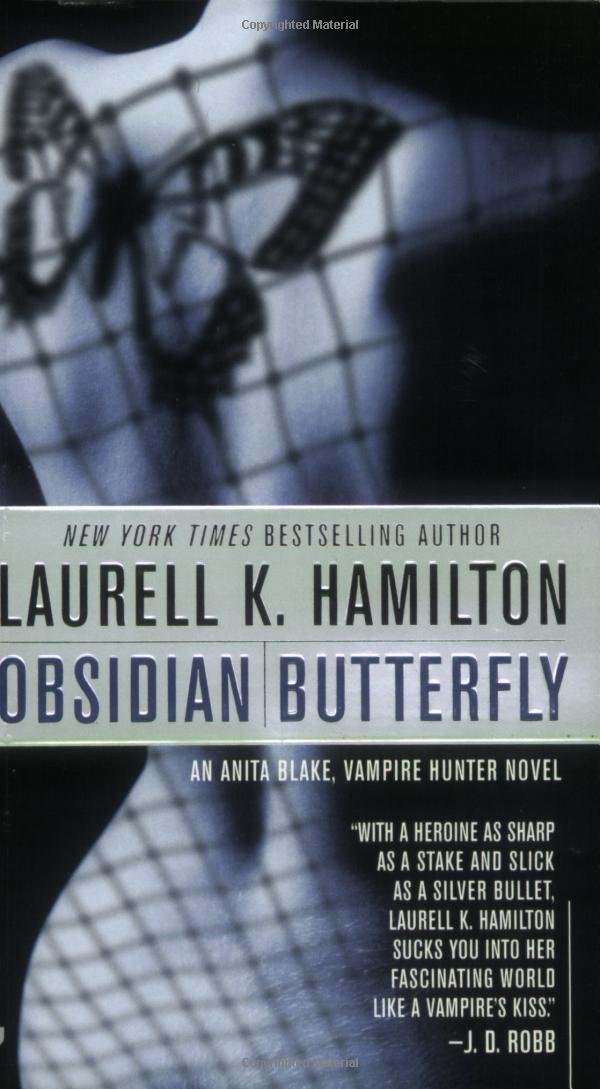
 Apparently, I have read nine Anita Blake books over the past year and a half. That seems like kind of a lot, although the year and a half part brings it back down to reasonable levels. Here’s the awesome thing, though. For the first time in a little while, I really liked this one. In Obsidian Butterfly, Anita is called upon by her mysterious assassin friend, Edward, to join him in New Mexico for an old-fashioned creature hunt. They, a Native American bodyguard-for-hire, and a misogynistic German serial killer must all join forces with the local police and the Feds to track down a creature that is killing a lot of people, and skinning but leaving alive a lot of other people. Since Anita Blake’s bread-and-butter is killing the vampires, the demons, the forces of darkness… well, okay, that’s somebody else. But Anita does it too, generally speaking. If you’re unaware of her, she’s this book series chick who raises zombies to ask them questions, and sidelights as a legal vampire executioner, whenever they get too uppity and outside the law. And those skills translate into hunting down were-creatures, witches and other spellcasters, fairies, and all the other non-mythical creatures that inhabit her Earth and go rogue from time to time.
So of course I’d like that, except that lately the series has run to vamporn more than detective-y awesomeness. Which is what made this book so much better than lately. All of the ‘Who will I choose?’/’Getting my hump on is immoral, but he’s so dreamy!’/’Check out this awesome new power I have thanks to my ongoing relationships!’ stuff has been put on hold, to settle into an old-fashioned investigation and hunt. It’s possible that this reset to the early series values marks a Vampire Hunter renaissance, and I’m really going to like the next few books? It’s a nice thought.
Especially because the editing was atrocious, and having to deal with that in addition to lame storyline will make me very sad. The badness was due to repetition. If there’s one thing I really understand about this book, it’s which people have empty eyes signifying that their soul has eroded away. Because I was told about it on an average of once or twice per chapter, spread out among a very few number of characters. And this book has 60 or 70 chapters, just so we’re clear. But even worse than that are the moments when Anita monologues internally about her opinion on this person’s motives or that person’s effectiveness, and then speaks those thoughts aloud (presenting them almost exactly the same way she thought them) to some character or other that was in the room with her when she was thinking to herself, all on the same page. Speaking as someone who can maintain attention to the plot for longer than 90 seconds at a time, this was an exercise in pain. It’s possible that this speaks to just how much I enjoyed the plot, that I was only rolling my eyes at the prose rather than having it make me want to claw them out.
Comments
3 responses to “Obsidian Butterfly”
Yeah, the writing just gets worse and worse as the series goes on, this was still my favourite of the last couple of books in the series though.
[…] Okay, that was trite even for cover-copy, much less a review. It’s like this. Death (the anthropomorphic personification, thin fellow, carries a scythe) opts to take on an apprentice, pass on the trade as it were. Mort learns the importance of the job that might one day be his, Death learns the importance of a vacation, and the reader learns, at excruciating repetition, the way that light and dark work on the Disc. But really, other than that (which I’m sensitive to after the last Anita Blake book), this was a fun, breezy book. The breeziest examination of causality and predestination I’ve ever read, in fact. […]
[…] The funny part is, I was praising the last book for being so much more on target than the couple before it. The way this was accomplished, I have since realized, was by taking our Anita out of her home turf, out of the range of her various boyfriends, and putting her somewhere completely different with a man with whom she has only a strictly professional relationship, and helping him solve a mystery. How did I realize this, you ask? By virtue of the fact that Narcissus in Chains is the exact opposite of that book in practically every way. […]