Category Archives: Words

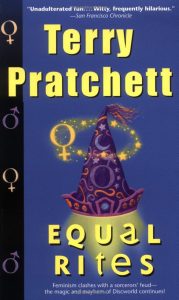
Equal Rites

61qUrH54OmLAnother week, another Pratchett. Although I expect that ratio to drop off a bit now. This time, Equal Rites, the story of a young girl trying to make her way in the world as a wizard. Which should be no problem, except for how only men can be wizards. (And suddenly, the title makes all kinds of sense.)
Here’s the thing. I know these are funny. I’ve read at least three of them, even before this latest spate. And the common knowledge is that ER is substantially better than even The Light Fantastic, but I found that they were mostly equivalent. Well, for the humor value, at least. ER had the better story, but it was a little too obvious for me, I guess.

Except, that’s not it either, exactly. It was more travelogue than battle of the sexes. So I guess part of my complaint is that it failed to meet expectations, and then once they got to the part I was expecting, it seemed rushed and simple. After a fairly contrived ‘nobody else could have accomplished this!’ moment that seemed to have nothing to do with gender, suddenly girls are allowed. Maybe I just didn’t get it.

Disclaimer: Still very enjoyable light reading. I think it suffered from inflated expectations more than any other single problem. I’m ready for the series to be as funny as I remember, though, and am starting to fear it’s the age difference. (That part probably shouldn’t have been in the disclaimer, but I’ve been trying to get this written for almost a day, and I’d rather be done than clear or concise.)

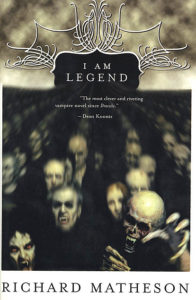
I Am Legend

Several weeks ago, a friend of mine recommended a horror author I’d managed to never hear of, Richard Matheson. I found a copy of A Stir of Echoes in my local Half Price Books, and I later read it all in one afternoon, while I was stuck at home watching the floor guy take up all of my downstairs linoleum. I’d seen the movie, and the book was largely the same, but just different enough to keep the mystery in real doubt all the way through. In any case, I enjoyed myself. Part of it was reading a book in one day, something I haven’t done in, well, I sincerely cannot remember how long.
In any case, I finally got to a better stocked HPB and found several more of his books, mostly in Penguin-sized short story collections. The one I’d been looking the most forward too was I Am Legend, the story of the last man alive in a world full of vampires. As it happens, the copy I got is about half that, and about half several more short stories, which I have yet to read.

Good story, though. In addition to Matheson’s drive to find a scientific explanation for every vampire characteristic, he explores themes of isolation in familiar but well-written ways and themes of identity in ways that I hadn’t considered before. What makes a man good? What makes a vampire bad? Is it possible to cross those lines? Is it desirable to?

I know that I just said it was cool to read a book in a day (and I could have done with this one, although I did not), but the one weakness I found was that I was never able to get all the way into the head of the main character. The whole story was from his point of view, and I didn’t really feel like I knew him any better by the end than I did in the first ten pages. He was an excellent means to Matheson’s multiple ends, but I’m not convinced he was more than that. I actually felt more for the three main ancillary characters than I did for Robert Neville or his (expired, at the opening of the story) family.

For now, though, I have all those short stories left to read.

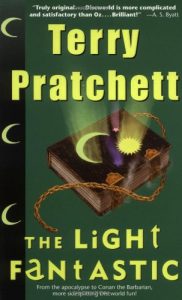
The Light Fantastic

5123VpObYZLJust as I predicted, The Light Fantastic removes most of the complaints I had about The Colour of Magic. Despite being published three years apart, it’s clear that these are one book split in half. Which is nice for me; I’d intended to read something else in between, but there was an unfortunate circumstance whereby I got called away on my weekend suddenly and forgot to grab a new book to read. Luckily, tLF was still in my trunk from when I borrowed it, though.

So, over the past five days, I’ve gone through that at a pretty quick pace. (Quick for me, anyway.) In addition to making up for the abruptness of the previous book, it’s also much more internally coherent and rather a lot more funny as well. Pratchett certainly improved between the two books. Not only that, but the lead characters became less inscrutable (Twoflower) and more likeable (Rincewind). On the whole, then, this was the perfect fluff book to read while hanging about in hospital rooms. I look forward to more of them.

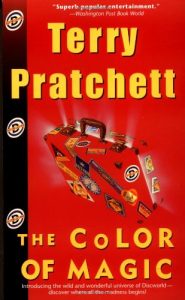
The Colour of Magic

516nJNmb2xLWeird. I’ve read a few Discworld books, mostly in high school, and I’m quite sure that one of them included Rincewind and the Luggage. But it wasn’t this book, and it doesn’t seem to be the next one either. So I’m a little puzzled on that score, but it’s okay. For one thing, this is brand new, completely uninfluenced by my memory, so that’s good, I guess.
Unfortunately, I can’t really add anything that’s not already been said on the topic. It was amusing, but not nearly as funny as I remember Pratchett being. Rincewind is a barely sympathetic character, the Luggage is more menace than lark, and Twoflower is okay, but he’s written as too mysterious to really get into him.

The plot was fine, but great sweeping swathes of it were missing for no clear reason and it ended with essentially no resolution. The Light Fantastic appears to be a direct sequel, and perhaps he already knew he was writing it when The Colour of Magic came out, but it was a bit jarring of my expectations since I know that these are traditionally stand-alone.

Mostly I’ve complained, so I will say that I got the occasional laugh and never regretted the time I was spending reading it. Plus! Now I understand the Tourist from nethack, so that was worth the price of admission.

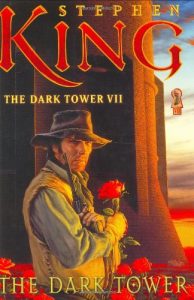
The Dark Tower

I’m having a tough time with this one. Obviously in part because it’s the last book of a series. Also because it’s (apparently) Stephen King’s last book in general, and I have a lot of respect for the guy.

Not for the prose. Particularly in The Dark Tower (which is the seventh volume in the series of the same name), and particularly early on in it, some of his verbal tics were starting to be really grating. On the one hand, I have a sense that some part of that is to draw you into the world of Roland of Gilead, but on the other, I have the very strong sense that this kind of thing shouldn’t be necessary to draw the reader in. And for that matter, I doubt it would have been, for me. I’m not sure if the flaw is in King for not trusting his material enough to stand on its own merit or if my theory is wrong and the tics are just there because he enjoys them. At any rate, it was never bad enough to make me want to stop reading, and it eventually either lessened or faded into the background for me.

Not for the plotting, either, although this book was reasonably well plotted. Certainly some of his books are not, but that hasn’t stopped me reading them, and probably won’t stop me re-reading them. Even when plotted well, he relies on scripted fate to get his characters out of certain situations. This bothers me, sometimes, because deus ex machina is usually pretty lame, even when it’s explicitly laid out. But then, it would have been fairly easy to not put the characters in a situation that required it, and also it helps / hinders the protagonists and antagonists alike. So, I think it might be partial commentary on the idea. Either way, this only has a minor negative (or positive, depending on my frame of mind) impact on my enjoyment.

No, what keeps me coming back is how good a job he does of presenting the story. He has a distinctive voice, which only helps, but I find it so easy to consider it a story I’m being told, across a fire, say, or in an open amphitheater. It’s comfortable.

That said, I’ve barely touched on the book itself. And probably I won’t much more, because if you haven’t read the previous books, it’s hard for me to do more than recommend the series, and if you have, I’m pretty sure I won’t be convincing you (or not) to read the last one. What can I say, though?

There were times when I read it voraciously, and had to slow myself down and enjoy it. There were times when I read it slowly, because I didn’t want to come to what was about to happen. I had horror in my heart, joy lighting my face, and more than once visceral fear (because it always comes back to a spider eventually, doesn’t it?). All because of how well he tells a story, sure, but I’m talking about my reactions to this story, not just to his skill at it.

The Dark Tower series as a whole weaves a good yarn. Some would say self-indulgent, but I thought if anything that the self-indulgent parts are more likely to be self-flagellant, from the author’s perspective. In any case, yeah, the author continues to appear in his own work in this book as he has in a couple of previous ones, and it still works. I know I wouldn’t believe that if someone were telling me, but it does. The costs and the redemptions are balanced. That is to say, King rarely tells a story where everything works out for the good guys, but this book is not one of his bloodbaths just for the sake of the blood, either.

Yeah, I want to say more, but that’s really all I can say. It’s a good story. That’s enough to convince me, because it really is quite good. Also, it (the series) has what I maintain should be placed among the very best opening lines in literary history: The man in black fled across the desert, and the gunslinger followed.

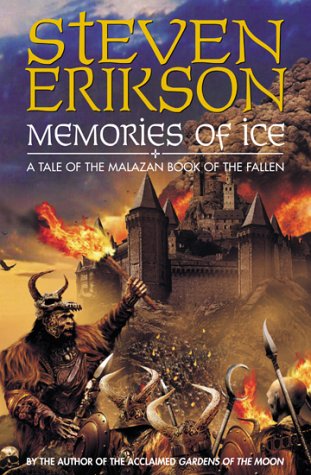
Memories of Ice

51B5H7HRP0LThe problem is, I’m about to gush here, and I don’t really want to, because who would take that seriously? Anyway, I decided to pick up Gardens of the Moon last year after seeing it praised so often on my Usenet hangout. And I gotta say, good book. I was confused for the first few hundred pages, and in some ways I still am, but it wasn’t a ‘story is incomprehensible’ confusion, just an ‘I know there’s a lot more here that I can’t see yet’ confusion. (The book is now being published by Tor, which means that it’s more available at a slightly cheaper price, but has worse cover art.)

I grabbed the next one a few months later, was a lot less confused, and by the end… wow. This Steven Erikson guy knows what he’s doing. I’m thinking that each of these books has its own enclosed theme, and that the theme of this one was sacrifice. Also, I’m thinking that he has, independently of whatever else he hopes to accomplish over the ten volume Malazan Book of the Fallen series, set out to become the definitive author of war imagery. There might be a better depiction of an army on the march through hostile territory, bereft of supply lines out there in the vast expanses of the written word. I know I haven’t found it, though.

And now, Memories of Ice. Both it and the second book, Deadhouse Gates, are sequels to Gardens of the Moon. As such, one could probably choose to read the pair in either order and not have the story spoiled. Of course, the reveal of his world’s secrets is linear, so a few parts of that aspect would be ruined. Most importantly, though, if book 2’s theme was sacrifice, book 3’s is redemption, and that’s not really the kind of thing that you’d want to get out of order, for fear of cognitive dissonance.

Although there are lot more familiar characters that have returned for this volume than for the previous, Erikson never stops introducing new ones. Characters that are almost instantly likeable and, more importantly to me, that are often instantly important to the overall story being woven. The problem is, characters die almost as often as characters are introduced. This is inevitable, though. The very title of the series demands a price in blood. What’s hard to distinguish, from an external perspective, is if the price is ever worth the gain. Don’t take that as a criticism, though. It’s almost always worth it from the perspective of the players, and that’s important. It’s only from my perspective, where characters that I like die to save faceless and often explicitly unworthy civilians, that the cost is high.

Speaking of war, Erikson’s grasp for the definitive this time is the siege. For about a hundred pages in the middle of the book, the city of Capustan is surrounded and assaulted by (of course) vastly superior forces. He put together a chapter that covers a straight 24 hours, in excruciating detail, while at the same time managing to convey the fog of war. And the horror of it; I will now digress for a moment. The soldiery is, for the most part throughout these first three books, very egalitarian regarding gender. As close to a 50/50 split of men and women as makes no difference. Erikson presented evidence of a female soldier having been raped by a male of the invading forces, and I had to do a triple take before I realized that the point they were making is that this kind of thing basically never happens. Brutal though that world is, I was impressed at how much more right they have it than we do, sometimes.

I have three complaints. One is that there’s a decided Fizban factor at work. It may not be the direct analog I was sensing early in the book, but until I find out exactly what’s going on, I’m going to stay annoyed by it. And quite possibly after I find out, if I’m correct. The second is minor, because it’s so brief. There’s a 5 page digression where a few of the main characters meet up with the army’s assigned painter (to capture the history and all, you understand) and his critic, a talking toad. It came from nowhere, and led almost nowhere. (There’s a slight bit of payoff loosely attached to my third complaint, but not enough to justify the jarring weirdness of it all.) The third… well, I’m not sure how to go into it while avoiding major spoilers, so it will go below the cut.

In any case, read these books. They’re each very long, so I can understand how they might seem like a slog if the first book doesn’t immediately do it for you, but there is some real payoff later in the series. And more to come; after reading this one, the titles of the next two (House of Chains and Midnight Tides) mean enough to me to expect more of the same out of the overarching story that ties it all together. And the quality of the writing is enough to expect more of that buttery goodness.
Continue reading

A beginning, but with less wind than that

Once upon a time, which is to say back in May, I sent an email out to a few friends who wanted recommendations for something new to buy and read. I reproduce that email, largely unedited, here. For a few reasons: It hints at stuff I’ve liked to read over the past year or two, it gives me something to start with that isn’t very, very lame (you think I’m joking, but just wait until you see #2), and it gives me something to put in without much thought at this moment, since I’m also still neck-deep in getting the layout and functionality for the site that I want. At any rate, expect these not really to be actual reviews so much as tiny encapsulations of enjoyment.

Not that any of this matters to you people from a strange and mysterious future who will be reading it in the archives.
Continue reading