Tag Archives: graphic novel

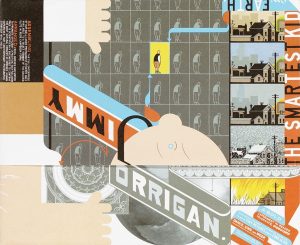
Jimmy Corrigan: The Smartest Kid on Earth

I think what keeps me from reviewing this graphic novel is the fear of being sucked back into the depression of it all over again. So I sit here staring at the blank screen that is in one incarnation or another over 24 hours old now. Which I’ll have you know isn’t all that uplifting itself, even by comparison. Therefore, I’m going to buckle down and power through it.

So there’s this dude, Jimmy Corrigan, right? He is named after his grandfather. In one timeline, adult semi-modern Jimmy is slouching towards middle-age in an apparently dead-end job with only his nursing home resident mother for real human contact. In the other timeline, young James is trying to survive his abusive father’s daily tirades while navigating the casually racist turn of the century Chicago school system. Both of these people are missing a parent, both of them are desperately unhappy with their circumstances, and both of them are due for a gradually worsening spiral from these rosy points of origin.

Without all of the misery bringing me down, there would have been a lot of interesting things to take note of. For example, the women in Jimmy’s life almost never have faces. (Notably, the only ones that do are women that James has seen.) Both men have vibrant fantasy lives; James’ allows him to briefly escape his genuinely tragic circumstances, while Jimmy’s is mostly farcical reimaginings of how his life might be going instead, each of them ending more pathetically than the already quite low reality. I suppose the point of the exercise is to watch each of them gradually get past their current lives and into a better place? I will opt not to reveal the secret answer to this question. I am willing to divulge that Jimmy Corrigan is not the smartest kid on earth. In fact, that may have been an example of this newfangled irony thing I keep hearing about.

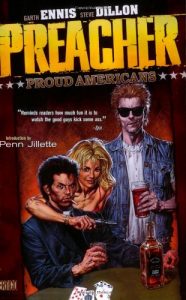
Preacher: Proud Americans

The only problem with modern graphic novels is that they fly by entirely too fast. I feel like I’m doing the art this massive disservice, even though I try my very best to linger over it. In any case, I continue to greatly enjoy the Preacher series, which as of this afternoon I am now a third of the way through. If the second volume was meant to be a reflection upon family and love, then by all means Proud Americans is an investigation of friendship and loyalty.

Preacher’s third entry begins where the second left off: Cassidy the vampire is in, er, mortal danger, and only his friends Jesse Custer and Tulip can save him. Trouble is, it’s a trap set by the mysterious Grail order, tasked with maintaining the bloodline of (familiarly initialed) Jesus Christ and interpreting the signs that will tell them when to trigger the apocalypse. Rife with fortunate meetings, fatherly reflections, fallen angels, flying bullets, Ferrari thefts, and literal fireworks, it’s not hard to see why I’m enjoying this thing so much. Sure, Jesse doesn’t get much closer to his showdown with God, and it’s possible by the end that he’s finally made an enemy he can’t afford to have. But with so many perfectly captured moments whirling through my head right now, I won’t have any problem letting myself wait a few months to see what happens next.

I’m left annoyed by what seems to me to be an unnecessary misstep, though. With so many fully realized heroes and villains wandering through the piece, it becomes lame that the few glimpses we’ve had of God leave him seeming so cartoonish by comparison. Obviously, I haven’t gotten nearly far enough into the thick of the plot to pass judgment (so to speak), but I anticipate being pretty disappointed if such a good story ends up being purposed mostly as an anti-religion wank. There’s way too much here for it to end up being petty.

Cowboys & Aliens

I have a local comics-y friend who acquired a copy of Cowboys & Aliens and immediately thought of me. Of course, I had just started a reasonably large book, so there has been delay. But that’s alright, as I’m here now. Apparently, you can get this slim graphic novel at your local store just by buying something else, and they slip it into your bag as a promotional item, I guess? Or maybe vast quantities of overstock.

That last one fits pretty well. The art is fine, but the plot is uninspired at best: when aliens crash-land in somewhere in the Old West, cowboys, Apaches, and settlers drop their petty feud over land theft and genocide in the face of a common foe who, sheerly by coincidence and I’m sure with no thought to parallelism, hopes to steal land and commit genocide. Then they have a fight, in which people die and things explode. My favorite part (and I refer here to my least favorite part) is the opening screencrawl segment in which all of the parallels that I earlier lied were coincidental are spelled out in excruciating detail before the book proceeds to unsubtly (but much more forgivably) present them via the plot. Explicitly, at one point.

In case you’ve missed it, though, I’ll go ahead and mention it a fourth time, now. Whitey rampaged through North America during the 19th Century, not for the first time, but the most aggressively and rapidly of any post-Columbus period. It’s possible there was something morally questionable about that, as presented by the Golden Rule, aka alien invasion. There. Now you’re probably prepared to read this, in the manner the authors were hoping for you to be. To end on a positive note, though, the cowboy hero’s name is Zeke. Which you must admit is a pretty awesome name. (I mean that. Don’t make me get a court order.)

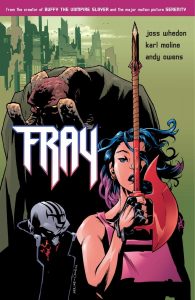
Fray

This graphic novel thing has gone pretty well. Enough so that I’m definitely getting more. There are, as nearly as I can tell, piles upon piles of awesome stuff out there. Most of it, stuff that doesn’t consist of the superheroes and things that everyone has heard of and about whom so many movies have been made, although there’s certainly a fair share of that as well. Alternatively, I’m a reasonably easy audience, as long as the art is comprehensible (and non-ugly: I hate the ones where every edge is jagged and impressionistic and melty and drippy) and the subject matter more than mildly entertaining, or if it happens to fall within my niches, which comics nearly always do. It would not be the first time I’ve been accused of being easy. Audience-wise, I mean.

In any case, I’ve reached the last of my carefully doled out graphic novel birthday extravaganza. From here on out, I’m on my own. (Except that some of them are series, and I can just keep getting more. Plus now I’ve got a few authors to reference. It’s all good.) This most recent one was written by Joss Whedon, a guy you may have heard of who has been involved in a few TV shows and a couple of movies. This was his first foray into comics, though I hear he’s become a big name in the X-Men series in the time since. Fray is set in the Slayer mythology, although there are hints in the linguistic drift that indicate the Firefly world is the same one as well.

Eponymous Melaka Fray is living the hardscrabble life of a have-not in a dystopian future where the line between rich and poor is every bit as stark as we’re used to seeing in Bladerunner, Neuromancer, and other examples of the genre. Unusually good reflexes and strength have given her the edge to be a pretty good thief, so she does alright, at least until her past and her fate conspire to catch up with her during the same long weekend. Because Melaka has been Chosen, the one girl in her generation with the abilities to fight the vampires, the demons, and the forces of darkness, who had been banished from the world for centuries. Until now.

Dramatic, huh? Anyway, it’s pretty good, and explores some of the same themes as Buffy: finding one’s place in the world, the nature of family, and so forth. I was a big fan of the art, especially the bold, heavy inking. And of course the dialogue and pacing. The biggest problem was that the themes were shallowly explored. It could have been a much deeper story if it had been spread out over two or three novels instead of all crammed into one. And this despite a dangling ending that implies a lot more could have been written. In short, frenetic plot equals good, rushed theme resolution equals bad. And I know for a fact he can do better than this. Interestingly, I think this would have made / could make a good movie in which the pacing of the theme would not seem nearly as much out of place.

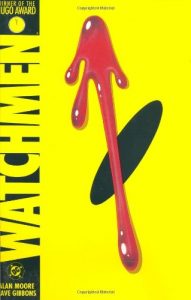
Watchmen

And so I continue through my list of genre greats. I avoided reviews of stuff while I was reading these, because I’ve mostly been able to not spoil myself on any given comic up to now, and it would be pretty awesome to not do so now that I’m actually reading lots of them. But I’m pretty sure that any random review of Alan Moore’s Watchmen will tell you that it’s a seminal masterpiece, or a watershed moment for the genre, or some other such reviewer-speak for ‘I liked it; now, you must also like it’. So, I’m going to cut to the chase: I liked it. I am enlightened enough to know that my tastes are not universal, for some inexplicable reason, so I will not proceed to tell you must also like it. But you probably will.

Now is where a weekend of debauchery is causing me to struggle to remember what kinds of things I can say about it. In short, it’s an alternate history where the comic book heroes of the late 1930s caused real people to start donning masks and outfits and engaging in enlightened vigilantism. Which was all well and good until the second generation of costumed heroes in the 1960s changed the world in drastic ways; by 1977, nearly all of them had been outlawed. Now, in 1985, the world hovers on the brink of catastrophe and, as ever, only the heroes can save the day. The problem being, most have retired; one still operates due to his uncompromising moral code, despite being more wanted by the law than most of the criminals he continues to take down. And of the two who are still government-sanctioned, one has just been murdered. The most important question being, was it random, or was it part of a far-reaching plot to neutralize any and all of the heroes who might yet be willing to step in and stop the clock before proverbial midnight?

Okay, I’m forced to admit that wasn’t short. And yet I’ve barely scratched the surface. That’s because the book is about almost everything: the relationships among heroes, of course, and between heroes and the public they serve or menace (depending upon who you ask); from where power most justly derives, and to where (“Who watches the watchmen?”); whether governments or lone vigilantes, either one, can justly use the power they have rightly or wrongly acquired; and whether it is permissible to sacrifice the few to save the many, at both the macro and micro level. Less thematically, it’s about how close to the brink of nuclear war we really were in the 1980s, and about noble last charges, and about allegorical pirates. In the words of a certain pirate in the current popular consciousness that, when taken allegorically themselves, very nearly fit: “You’re off the map. Here there be dragons.” And as much as I really approve of maps, the most interesting things happen when off them.

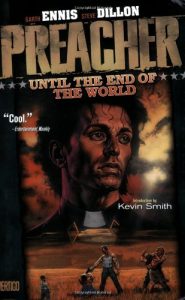
Preacher: Until the End of the World

When last we saw our hero, preacher Jesse Custer, he was on his way back to Texas to follow up some leads on the whereabouts of God, who to Jesse’s way of thinking owes him an explanation or three. But if there’s one thing that can get in the way of a perfectly good spiritual quest, it’s family business…

I said that unless something went horribly wrong, I’d be buying more of this series. I can say with a great deal of assurance that something has gone horribly right. Until the End of the World, the second volume in the Preacher series, ratchets up the sex and the violence and the fiery theological debate, and adds in family themes with depth that would feel right at home in a Gaiman comic and a love story that could measure up to anything written by S. Morgenstern. Can I hear an Amen?

Also, I’m really curious to discover what Skwid was referring to by conspiracy theories. So yeah, I’ll be ordering more of these as soon as I can feasibly do so, I think. In the meantime, still a couple of entries in the gift pile yet to go.

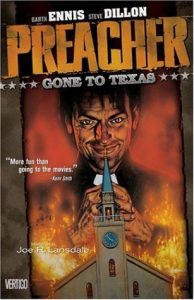
Preacher: Gone to Texas

When I received all of these graphic novels, it was in response to my thinking aloud over a period of time as to how I have so little grounding in especially the history and high points of the comics universe, despite knowing pretty well what’s going on in any given movie. So, I got some old stuff as well as some landmark entries. It could be that the Preacher series is such a landmark, but it could also be that my fascist friend was simply tickled at the idea of a violent theological epic playing out in my home state.

Whatever the case, Gone to Texas, the first volume in the Preacher series, is an excellent book. A Romeo and Juliet story on a slightly larger scale than Verona results in a small town preacher with a murky past given power that is on the same cosmological scale as God’s own, or so it seems for now. Together with his ex-girlfriend and an Irish fellow with an aversion to tanning, he starts on a quest to find God and ascertain why He has abandoned His creation to the forces that have affected him so drastically, and which most recently have unleashed an unstoppable killer to end him for good.

The story is by turns horrific and hilarious, amoral and yet with an unshakeable sense of justice that nevertheless allows for the unlikelily absurd. And best of all, there’s no question as to whether you want to know what’s going to happen next from issue to issue, and frankly from page to page. After the trouble I had following the Dark Knight, I was pleased at the skill that must have gone into making each page chapter-like in its self-containedness. Not to mention that the art is pretty traditionally interpreted as well. Which it should be, because it allows the gruesomeness to be viscerally felt instead of disguised by the stylistic art that’s present in so many other graphic novels I’ve read.

I only have two of these, and I think there are nine in the series. Unless something goes drastically wrong with the second volume, I’m going to have to buy the rest of these and see how it turns out.

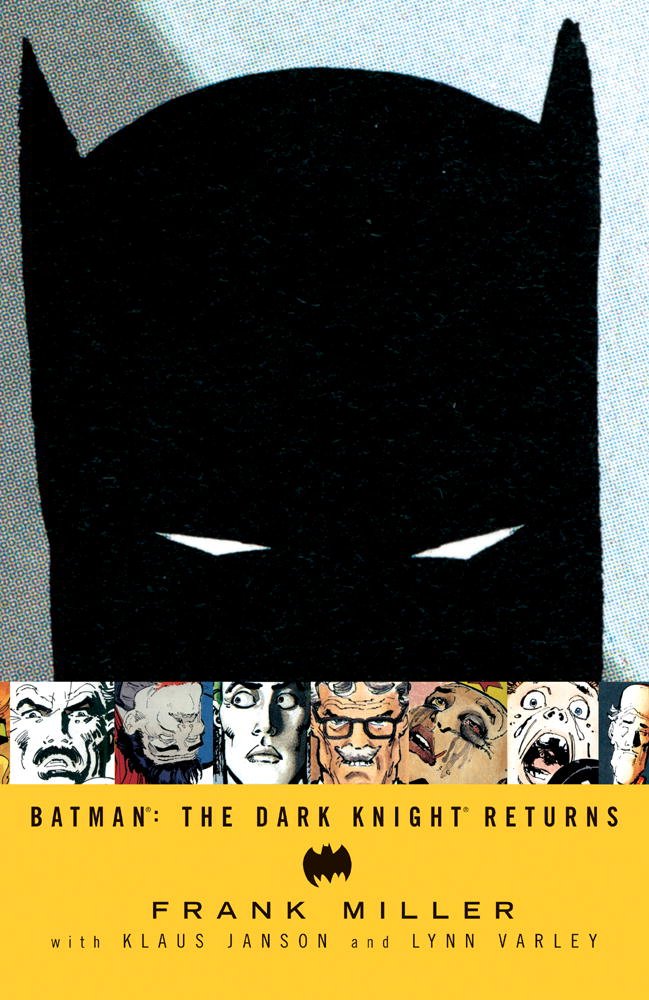
Batman: The Dark Knight Returns

61H8BOtqAbLThrough chronological coincidence, my next comic entry is an excellent choice to follow the previous one. Having seen where the Batman got his start, The Dark Knight Returns gives me a chance to see where he ended up. And where he ended up isn’t pretty.

One Robin, Boy Wonder has left him and a second has died in his arms. He has been retired for ten years, due to a nebulous agreement that retired or co-opted the other superheroes at the same time (save for Superman, who is now employed by the US Government). Gotham is overrun with crime, filled with gangs of teenagers who own the streets and can make and carry out threats at will. Commissioner Gordon is facing mandatory retirement, and among most of the talking heads on TV, the rehabilitation into society of such criminal masterminds as Two-Face and the Joker are cause for celebration at the success of the system rather than horror and fear at its failure.

Whether because of the declining morality of the youth population, because of guilt over his involvement in Harvey Dent’s (that is, Two-Face’s) inability to cope with his freedom and subsequent return to villainhood, or simply because he doesn’t feel like an entire man without the Bat, the re-costumed Bruce Wayne hits this socio-political climate like a thunderbolt, taking on the gangs, old enemies and old friends alike, condemned by cartoonish liberals for what he is doing to criminals and by cartoonish conservatives for what he is doing to law and order, and joined at an opportune moment by a new Robin. It’s a very raw take on an old man’s unstoppable crusade against everyone who brings society down instead of building it up.

Being raw, though, it does have its flaws. The stories are held together by the world around them, but seem pretty episodic in nature on their own. The art, while excellently frenetic, occasionally lends itself to being difficult to follow. It’s hard to really like any of the characters on a consistent basis (with the exceptions of Gordon and Robin). But flawed or not, it has the power of its rawness, and I’m not a bit surprised that the Batman mythos since this work has owed far more to it than to anything that came before, outside of those initial episodes that first set the character down on cheap pulp. (And which, frankly, were a lot like Frank Miller’s vision in this book. It’s much easier to imagine a straight line between the two graphic novels I’ve read that doesn’t go through Adam West than one that does.)

Also: as you’d probably expect, the Joker (newly revived from catatonia at the news that he once more has a nemesis worth committing senseless murder for) steals every scene he’s in, whether it be praising the media for being his own personal fan club, highlighting all of his criminal activity on the evening news so he doesn’t need to keep track of it himself or whether offhandedly promising to kill everyone within sight of his face and being laughed at for, well, joking (he was not, of course). It’s easy to make an argument that the Batman needs a Joker, an enemy that the forces of law cannot hope to cope with, that justifies his vigilantism. This story makes the far more compelling argument that the Joker needs a Batman; because, if there’s no chance of failure, is there really a point in proceeding on the basis of sociopathy alone?

[Late-breaking full disclosure: I actually read this in the Absolute format, but it contained two books, of which I still in 2015 have not read the second one. So it’s hard to produce a link and image for only half of a book, much less one that is by now long out of print.]

Batman: The Dark Knight – Archives, Volume 1

After the extensive silliness of the archival Superman collection, I was a little trepidacious at the idea of the cracking open the initial Batman collection from the same people. (Well, okay, the people are DC, so that’s kind of a dumb way to put it, I guess.) But for lack of a better system I’m reading them chronologically, and that one was next. Therefore, in I plunged.

I’m pleased to report that this was a much stronger entry off the bat. (Er. Sorry.) I found that I kind of missed the full magazine approach that the other one used; no text stories amid the comics and no X-ray glasses or Batman fan-club order forms for me. I think as much as the nostalgia factor, I missed them because it left me less certain that I was actually reading all of the first few Batman adventures. (It didn’t help that one episode referenced a previous encounter between our hero and the villain in question. I have no idea if it was an in media res device or an actual backward reference to a missing story.) And in one unfortunate occurrence, Batman stole a story directly from the Superman of the same period: a football player is kidnapped, so Bruce Wayne uses his make-up and disguise talents (which are, admittedly, a lot more palatable than contemplating Clark Kent’s, whose best disguise consists of a pair of unlensed frames) to render himself identical to the missing player and win the big game. That’s, uh, heroic.

But like I said, on the whole it was a much stronger book. For one thing, it had iconic villains from the earliest stories. While Superman is off fighting interchangeable industrialists bent on raping the middle class and poor countries around the world, Batman is fighting the Joker or Catwoman. Definite advantage here. I have to think the smaller scope in general is part of what makes him a better superhero for the ages. He can be hurt, he can face real setbacks, he has enemies that can make realistic plans to take him out of commission.

And, he has a sidekick that… well, okay, Robin bugs me a little bit, in that he seems to be as effective at sixteen as the full-grown man he’s working with, despite the latter’s drive to avenge his parents and past. (As I understand it, Robin has an equally grim past, but it was never delved into in this volume.) Plus, he’s always grinning widely. Artistic decision, sure, but it also bugged me a little. I guess it’s part of the propaganda portion. He doesn’t really have a character of his own besides ‘generically happy’. He is clearly there for no better reason than to stand in for the teenage boy reader, which isn’t so bad by itself, but then he’s constantly used in that role to teach moral lessons. And I know that’s probably more good than bad, but I’m here for the plots and the characterizations, and I’m simply not going to like it when things get in the way of that. So, less Robin, more Batman, please.

Anyhow, that was as minor of a concern as the football adventure, really. The point is, Batman is dark but likeable, easy to identify with, has excellent opposition, and is just downright fun. Plus, he seems more averse to leaving a trail of corpses behind him, which it took the (seemingly more moral) Superman a little while to accomplish. The misogyny, though, that’s still there. Sure, he keeps saving Catwoman from other villains and now and again from the law simply because he thinks he can get in there, someday. (And watching Robin be confused over that hidden motive was worth his character being present at all.) But that’s the kind of misogyny that I’d think a girl could get behind, if it means she gets away with thousands of dollars worth of jewels every so often.

It’s the other kind that made the book for me, based on the shocked giggles it provided. (I know it’s a double standard, but since it happened 65 years ago and is so, well, cartoonish on top of that, it just doesn’t feel real; as I know it couldn’t happen now, I permit myself some obviously morally defective enjoyment out of it.) I will now describe a single panel of the book, from Batman’s first encounter with the Cat. Awful, I know. But also kind of awesome? You be the judge.

He has just removed the old lady wig, revealing Scooby Doo-style that she’s the villain. Now, he is forcibly wiping the old lady makeup from her face. She cries out, ‘Let go of me!’ His response: ‘Quiet or Papa spank!’
Endless Nights

Seven stories, one for each of Neil Gaiman’s Endless siblings. It wouldn’t seem like the best description to drum up interest in the newest (although not so very new) Sandman graphic novel, Endless Nights. At least, it wouldn’t to people who aren’t familiar with the series. If you are, seeing Neil Gaiman’s name attached to this property most likely comprises one of the few value guarantees out there. (I’ll try my damnedest not to gush further, when the next one of these comes up.)

Impressions: Desire’s story made me like it a little, which I’m not sure I ever had before. (Not that this lasted for very long.) Despair, although not an actual tale in the conventional sense, was gut-wrenchingly effective. Destiny is as uninteresting as he ever was, but I don’t think it’s his fault. Ten panels of Delight was enough to break my heart. Gaiman’s smart, to use her as sparingly as he has over all these years.

Finally, there are a couple of spoilers about the main sequence stories included here. That story is a lot more about the journey than the destination, but also these would probably be easier to appreciate by knowing the characters more thoroughly, anyhow.